How lifestyle campaigns on in-store screens build brand visibility and recall
Why lifestyle films work in stores, how to make them for a screen, where to place them and how to run one campaign across every store.
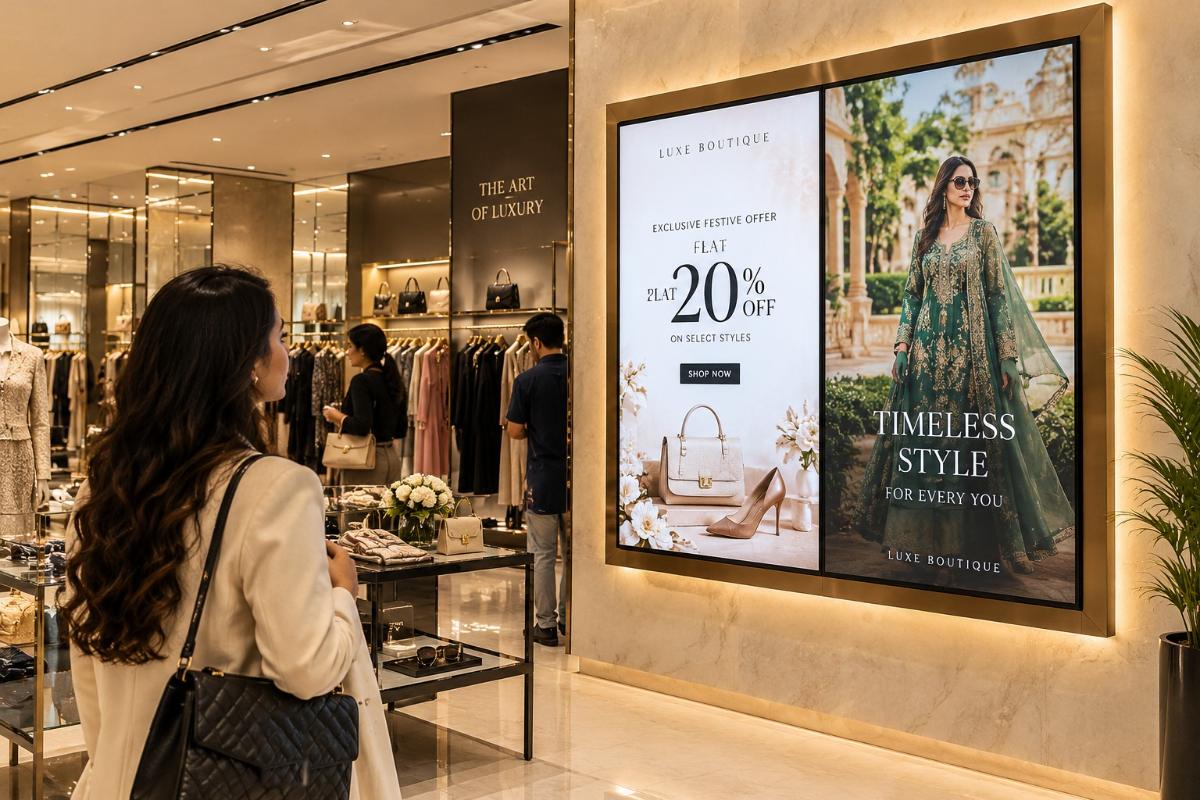
Why lifestyle content works in a store
A product shot tells people what you sell. A lifestyle film shows who it is for: the wedding, the weekend trip, the first day at a new job. Shoppers in a store are already thinking about buying, and seeing the product in a real moment helps them picture themselves in it.
That picture is what people carry out of the store. It is the start of brand recall.
Recall comes from repetition and consistency
People remember brands they see often and in the same way. A campaign that looks the same on the hoarding, on Instagram and on the screen at the store entrance reinforces itself every time someone sees it.
When some stores run last month’s creative, or each store makes its own version, the message splits. Publishing centrally keeps every store on the same lifestyle campaign, on the same day.
Read next: Keep the brand, allow the local: content governance for chains
Where to place screens for brand visibility
At the window or entrance, to stop people walking past. Near the product, so the film connects to what is on the shelf. At the billing counter, where people stand still for a minute and the last impression forms.
Read next: Content ideas for retail store screens
Make the campaign work on a screen
Keep each clip to 10 to 15 seconds, because most people see a screen for a few seconds as they pass. Assume there is no sound and let the visuals and a few words carry the idea. Show the brand early, not only in the last frame.
Use one idea per clip and rotate three to five clips, so regular customers don’t tune out.
Time it to the season
Festive, wedding season and end-of-season sale campaigns all have fixed dates. Schedule them weeks ahead so they go live in every store on the first morning and come down on the last day, with no store visits.
Ivana Jewel, for example, runs collection films and festive campaigns across 15 stores from one ScreenZap account.
Read next: Jewellery showrooms: rates and wedding-season campaigns in every store
Measure what you can
A screen won’t tell you directly how many people remember your brand. What you can track is whether the campaign went live on time in every store, how sales of the featured products moved during the campaign, and what customers say when staff ask where they saw it.
Run the campaign in a few stores first, compare them with stores that didn’t run it, then roll it out.
Run one campaign across the whole chain
Group stores by city, format or region. Put the brand film in the main zone of the screen and keep a smaller zone for a local offer, so stores get some flexibility without changing the campaign itself.
Frequently asked questions
Does digital signage improve brand recall?
It helps when the content is consistent, repeated and placed where shoppers spend time. Screens give you control over all three in every store.
How long should an in-store video be?
Ten to fifteen seconds per clip works for most stores, with three to five clips in rotation.
Do in-store screens need sound?
No. Plan every clip to work without sound; most stores keep screens muted or have background music playing.


